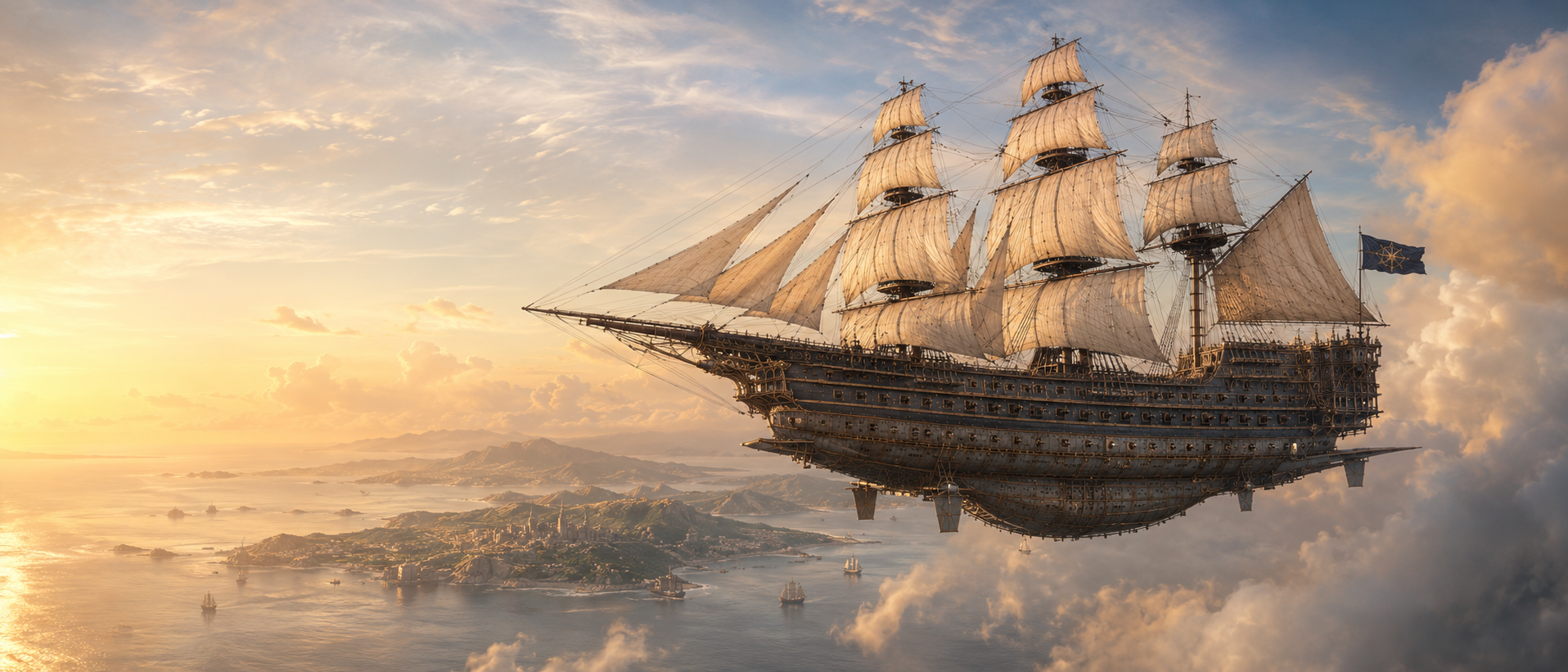
An airship appears slowly enough for the eye to misunderstand it.
First come the masts above the cloud.
Then the canvas.
Then the dark length of the hull, carrying guns, timber, iron, stores, machinery, and people where nothing so heavy should remain.
From below, it may resemble a ship lifted whole from the sea.
It is not.
Every line of the vessel has been changed by flight. The hull is built around a structural spine no ordinary ship requires. Compartments have been surrendered to lift chambers, regulators, pumps, cooling runs, and ballast controls. Fins and strakes steady a mass that still resists every turn. Guns are carried along structures strong enough to survive their recoil while the vessel hangs above open air.
A Mar de Oro airship should look old and new at once.
The sea taught people how to build it.
The sky taught them what had to change.
12 sections
The first vessels to rise were experiments.
The Forty-Two Years’ War made them ships.
The war, remembered as the Forty-Two Years' War, ended with the Treaty of Sunhold in 7151 PSE. Before that treaty, the Valdegracian Empire had already invested in airship development. Its yards possessed the oldest continuous tradition of building vessels capable of repeated military flight.
Early lifting craft proved that active Éterlumin could reduce the downward load carried through a hull.
War demanded more.
A military airship had to cross distance without a harbour. It had to carry dispatches over broken fronts, observe fleets through weather, deliver specialists where roads had failed, and place guns above positions that had never been designed to answer an enemy in the sky.
It also had to return.
That requirement changed the work.
A powerful chamber was useless if the hull twisted around it. A vessel that rose once and broke on landing was a demonstration, not a weapon. A craft that required a university workshop after every flight could not survive campaign service.
The imperial yards therefore pursued endurance, distributed support, repairable systems, trained watches, and structural continuity.
The breakthrough was not flight alone.
It was repeatable flight under wartime conditions.
The first useful airships gave commanders something no sea-going fleet or marching army could provide. They became moving high ground, signal towers, batteries, instruments of intelligence, and a way to place exactly the right people or payload where no friendly port existed.
Once the Valdegracian Empire possessed that advantage, every rival power had to answer it.
Albion pursued speed, operational reach, concealment, and the ability to choose when an engagement began.
Other states developed vessels around commerce, convoy protection, refined sailing performance, or the defence of particular coasts.
Heller inherited Valdegracian foundations, then adapted captured, purchased, studied, and improvised systems to the needs of an autonomous frontier duchy. Its engineers learned to combine parts from traditions that had never intended to cooperate.
By the time the Treaty of Sunhold ended the war, the airship was no longer a court experiment.
The war had given it doctrine.
It had given it yards, classes, trained crews, maintenance records, engineering schools, failures worth remembering, and governments determined never again to be the only power looking up.
Airships did not emerge from a new industry.
They emerged from shipyards.
The people who built them were naval architects, shipwrights, sailmakers, gunners, riggers, metallurgists, and marine engineers. They already knew how to construct long timber structures that could flex without separating, carry heavy stores, survive recoil, and remain serviceable far from home.
They kept what worked.
They changed what did not.
The keel deepened and became the sky-keel.
Cargo spaces became machinery holds.
Ballast became part of flight control.
Masts and sails remained because wind could move a vessel for days without consuming fuel or filling the hull with more engines, shafts, heat, and maintenance.
Rudders were joined by steering vanes.
Fins, tailplanes, and angled strakes appeared where the hull required stability.
Lift chambers and lift-lungs were placed inside the vessel, connected to the structure that carried their changing loads.
This is why a Mar de Oro airship resembles an Age-of-Sail warship.
It descends from one.
But it is no longer one.
A ship cannot be lifted safely. It must be built for flight.
Doctrine
Every Mar de Oro airship follows the same physical rules.
Éterlumin reduces effective downward load.
It does not abolish mass.
The ship retains momentum, recoil, collision energy, heat, inertia, and structural strain. Every turn still requires time and distance. Every broadside still pushes against the vessel. Every loose object remains dangerous once it begins moving.
Lift and propulsion are separate.
Éterlumin keeps the vessel aloft.
Sails provide normal sustained movement.
Powered propellers are rare, costly, auxiliary, and closely guarded. They are not a universal part of airship design.
The sky-keel is integrated into the vessel.
It is not a magical bar bolted beneath an ordinary hull. It carries lift, torsion, recoil, and changing loads through prepared structural paths.
Every important system has a cost.
- More armour requires more support.
- More guns require stronger recoil paths.
- More lift-bank separation provides redundancy but consumes space.
- More machinery creates heat and maintenance.
- More cargo complicates trim.
- Greater speed often means lighter protection.
A vessel that does everything well does not belong in Mar de Oro.
No single hull represents every nation and class, but several features identify a Mar de Oro airship.
A long timber hull
The vessel retains the proportions of a working ship because it must carry people, guns, machinery, provisions, rigging, and stores across distance.
It should appear substantial.
Even the fastest sloop is not a delicate flying boat.
A deep structural centre
The sky-keel may be concealed within the hull, enclosed inside a reinforced engineering structure, or made visible through the depth and geometry of the lower vessel.
Its presence should be felt in the silhouette.
The ship has a spine.
Working sails
Canvas remains the ordinary means of propulsion.
Sails should look capable of moving the vessel, not merely decorating it.
Rigging, stays, yards, and control lines remain necessary. An airship under sail still negotiates with wind.
Stabilising structures
Rudders control yaw.
Tailplanes and horizontal surfaces assist pitch.
Fins, strakes, and short outriggers resist unwanted roll and help the vessel settle into a stable path.
These elements should look built into the hull, not attached as ornament.
Altered proportions
An airship may be longer, deeper, or more strongly framed than its sea-going relative.
Its hull form reflects machinery space, lift distribution, recoil paths, cooling, and the need to keep the centre of support aligned with the vessel’s mass.
Visible mass
The vessel should never look weightless.
Its sails strain.
Its hull lists.
Its turn carries drift.
Its frames answer recoil.
An airship does not dart.
It commits.
The exterior tells an experienced observer much about the vessel.
A deep keel suggests extensive structural and lift integration.
Large fins suggest stability, but may make sea handling poor.
Broad gun decks indicate strong recoil paths and substantial lift reserve.
Numerous vents suggest distributed machinery or heavy cooling demand.
A long, lean hull suggests speed and range, but may reveal reduced armour or limited redundancy.
External housings may provide easier access for repair while exposing systems to enemy fire.
Observation cages, fighting tops, command galleries, and signal positions reveal the work the vessel was built to perform.
Ornament also matters.
A ship is not only a machine.
It is an announcement of the institution that owns it.
Most of the vessel’s defining machinery is hidden.
Inside the hull are:
- inert Éterlumin storage
- active chambers or lift-lungs
- lift banks
- Fortera rods
- regulators
- pumps
- cooling lines
- vents and emergency releases
- ballast controls
- isolation valves
- machinery wells
- the structural connections that carry load into the sky-keel
This machinery should not appear as a collection of glowing external engines. The power of an airship is distributed through the vessel. Its danger is distributed with it.
A ship’s purpose determines its shape more strongly than its name.
Sloops
Sloops are lean and constrained.
Machinery occupies a greater proportion of the hull. Stores are limited. Gun power is modest. Redundancy is expensive.
Their advantage is speed, lower crew demand, and the ability to operate where a heavy vessel would be wasteful.
A sloop should look purposeful.
Nothing aboard has room to be accidental.
Frigates
The frigate is the balanced airship.
It combines range, sails, artillery, lift reserve, crew accommodation, and independent operation.
Most representative airship designs should begin here because the frigate shows every major system without the extremes of the lightest or heaviest classes.
Heavy frigates and command vessels
These ships require deeper structure, larger engineering spaces, more distributed lift, stronger communication systems, and greater redundancy.
Their silhouettes may include heavy side-masts, observation positions, reinforced gun decks, broad command galleries, or specialised machinery.
Aurora Ventus reflects this logic. Her deep sky-keel, angled strakes, heavy side-masts, fighting tops, and observation cage are consequences of her command and field-management role.
Ships of the line
A ship of the line is not merely a larger frigate.
Its mass changes everything.
The sky-keel must carry a far greater distributed burden. Lift banks must be divided and protected. Gun decks require exceptional reinforcement. Cooling, supply, and crew demands increase sharply.
Such vessels are slow to answer and expensive to maintain.
Their arrival changes the situation before they fire.
The laws of flight are shared.
The solutions are national.
Endurance, protection, authority
The Valdegracian Empire
Valdegracia possesses the oldest continuous airship tradition.
Its vessels favour protection, firepower, distributed containment, and structural resilience. Broad hulls carry powerful batteries and spread the lift system so that damage removes part of the vessel’s capability rather than immediately destroying the entire installation.
Heavy frames and enclosed engineering structures protect the continuity of the sky-keel.
The cost is slower manoeuvre, greater support demand, and broad turning circles.
The hull also carries imperial meaning.
Formal lines, ornament, gilded fittings, coats of arms, and substantial construction announce authority to anyone watching from below.
A Valdegracian warship is built to remain where doctrine placed it.
Reach, speed, initiative
Albion
Albion favours operational reach, speed, surprise, and the power to choose the engagement.
Its hulls are leaner.
Armour is lighter.
Engineering sections are more modular and can be isolated or replaced quickly.
Careful weight economy, disciplined maintenance, efficient sail plans, and generous stores allow Albion vessels to operate far from supporting ports.
Exceptional classes may conceal auxiliary propulsion within the keel or lower hull.
The cost is reduced tolerance for prolonged punishment once speed, steering, or rigging is lost.
Albion does not wish to endure the battle its enemy prepared.
It wishes to arrive before that battle exists.
Adaptation under scarcity
The Duchy of Heller
Heller works from Valdegracian foundations.
It also works from scarcity.
Its engineers adapt what they can acquire, capture, study, repair, or improve.
A Heller vessel may combine a Valdegracian structural pattern, an Albion mechanism, locally produced control systems, and alterations made by engineers who had no replacement parts and no permission to fail.
The result can be unusually capable.
It can also be difficult to standardise.
Heller design is not random improvisation. It is purposeful adaptation under frontier conditions.
Warships built from merchant discipline
Stroomdijk
Stroomdijk builds warships from the same principles that made its merchant fleets successful: sound hulls, efficient use of space, reliable sailing qualities, and no unnecessary weight.
Its vessels are broad enough to carry stores and guns without becoming cumbersome, with clean decks, practical rigging, and machinery placed where it can be reached by the crew. They favour steady handling and endurance over sudden speed.
Stroomish warships are usually powerful for their cost, but rarely extravagant. They carry enough artillery to fight in the line appropriate to their class, yet avoid the excessive structure, ornament, and specialised equipment found in wealthier fleets.
They are built to sail far, fight hard, and remain useful after the first battle.
A Stroomish warship is not a merchant vessel with guns.
It is a warship built by people who believe wasted space, wasted weight, and wasted coin are the same failure.
Balance and technical refinement
Luminore
Luminore favours refined hulls, strong sailing qualities, carefully prepared gunnery, and technical ambition.
Its ships may be individually excellent, but the fleet cannot afford careless attrition.
Balance, handling, officer quality, and favourable preparation matter more than the ability to absorb endless damage.
A Game Master does not need a complete technical plan to understand a vessel.
Reading the Cruzado
The Cruzado-type heavy frigate shows how much can be learned from a vessel before its crew or allegiance is known. Its deep hull, two-deck battery, extensive rig, reinforced sky-keel, lateral control fins, and stern rudder reveal a sea-going ancestry adapted for aerial warfare.
The result is a heavily armed cruising warship that can operate independently and survive sustained action. Its sky-keel and compact control surfaces adapt the inherited frigate form for flight without turning it into the narrow, specialised aerial weapon favoured by Albion.
To read any airship, ask two questions:
What is the design trying to protect?
What is it willing to sacrifice?
CapabilityA broad hull with distributed lift banks can survive local damage.
CostIt turns slowly.
CapabilityA lean hull can cross distance quickly.
CostIt has less room for reserves.
CapabilityLarge fins improve stability.
CostThey create drag.
CapabilityConcentrated artillery increases striking power.
CostIt concentrates recoil and weight in one part of the ship.
CapabilitySeparated machinery is easier to isolate after damage.
CostIt requires more space and crew.
CapabilityExposed systems are easier to reach and repair.
CostThey are also easier to hit.
A ship’s strengths should reveal its fears.
For play, every airship should contain enough structure to make decisions visible.
Identify:
- command position
- helm
- sky-keel route
- forward, aft, port, and starboard lift areas
- machinery well
- pump gallery
- regulator run
- vents
- ballast
- magazine
- gun decks
- cargo
- engineering controls
- at least two routes into engineering
- isolation points
- one obstruction
- one system the crew cannot afford to lose
The map does not need to answer every engineering question.
It needs to show where the characters must go, what stands in their way, and what will be lost if they choose a destructive solution.
Canon control
A Mar de Oro airship is not:
- a sailing ship suspended beneath a balloon
- an ordinary hull lifted by a magical object
- a weightless palace
- a modern aircraft decorated with canvas
- a machine covered in gears without purpose
- a vessel driven by universal exposed propellers
- a glowing engine with a ship built around it
- a design that ignores heat, recoil, ballast, or maintenance
- a ship capable of every role without compromise
There is no external balloon envelope.
Lift is carried inside the hull.
There is no reactionless thrust.
The ship remains part of the physical world.
Every airship carries the history of the war that made it necessary.
The hull comes from the sea.
The sails come from the wind.
The sky-keel comes from vessels that rose before their frames understood how to carry the burden.
Valdegracian breadth records an empire’s need for endurance and authority.
Albion’s lean profiles record a doctrine built around reach and initiative.
Heller’s altered vessels record distance, capture, scarcity, and engineers trusted to make incompatible things work.
The designs have not settled.
The Age of Flight is still early.
Every fleet contains ships representing what its builders believed ten years ago, what the last war proved wrong, and what the present government is unwilling to admit it cannot afford.
That is why a Mar de Oro airship looks old and new at once.
It is the Age of Sail rebuilding itself around a discovery it can use, measure, maintain, and still does not completely understand.