Fifth Edition Rules
Airship Combat for D&D 5e
Altitude, lift loss, Éterlumin Reserve, Overdraw, and boarding a flying vessel.
Airship combat uses the Naval Combat rules as its foundation. Use the same vessel attacks, Broadside damage, Combat Speed, physical protection, and boarding procedures, then apply the additional rules below for flight.
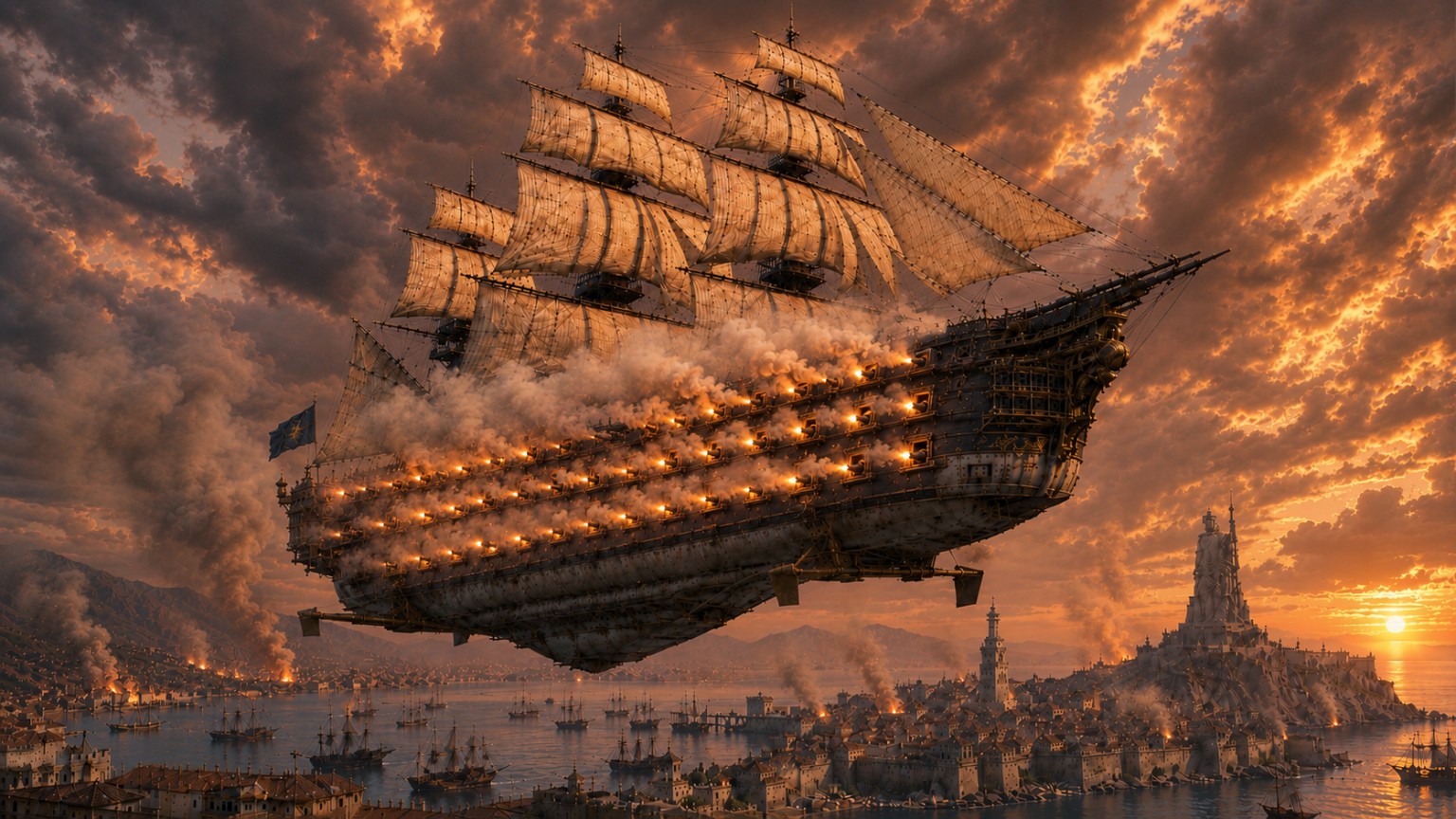
The guns themselves do not become more powerful in the air. An equivalent battery deals the same Broadside damage. The airship’s advantage comes from greater effective engagement range when altitude favours its guns, superior firing angles, substantially higher speed, and three-dimensional movement.
Read the base vessel rules → Naval Combat for D&D 5e
Crews firing across the rails use the D&D 5e firearm rules.
For the physics behind flight, read How Airships Work.
When you are ready to field a vessel of your own, the Airship Builder and Encounter Tracker helps you build a ship and track its encounters. Resolving the attacks stays at the table with the rules on this page.
Compatible with D&D 5e and D&D 5.5e.
Range
Altitude extends the practical engagement envelope of an airship’s deck guns. When an airship has a meaningful altitude advantage over a lower target and a clear firing solution, its effective engagement range is approximately 1.5 times that of an equivalent sea-level battery.
With a major altitude advantage, clear observation, favourable conditions, and an unobstructed downward firing solution, effective engagement range may reach approximately twice the normal sea-level engagement range.
This changes effective engagement range, not Broadside damage.
Two airships fighting at approximately the same altitude do not automatically receive the range increase against one another.
Angle
Airships fight in three dimensions. Altitude creates firing solutions unavailable to surface vessels. An airship can approach above conventional firing arcs, attack decks and exposed structures from elevated positions, cross terrain or fortifications, and change which parts of a target are exposed.
A favourable angle does not automatically increase Broadside damage. Its advantage is positional: an airship may be able to fire while the opposing vessel cannot effectively return fire.
Speed
Airships are substantially faster than conventional sailing warships. Speed allows them to choose engagements, reposition, pursue, disengage, exploit openings, and concentrate force more readily.
A sea-going ship may carry an equally destructive battery, but an airship is more likely to decide when and where that battery is brought into action.
Airships use the same optional Combat Speed rule described in Naval Combat. Their higher listed top speeds therefore represent an especially strong advantage in pursuit, disengagement, and positional control rather than permission to fire perfect broadsides continuously at maximum speed.
Vessel movement on a grid
Airship movement can be handled abstractly through relative position, altitude, firing arcs, and engagement geometry.
If you use the 10-yard Battlefield grid, treat 3 knots as approximately 1 square of vessel movement per round.
Divide the vessel's current speed in knots by 3 and round to the nearest whole square.
| Current Speed | Grid Movement |
|---|---|
| 20 kt | 7 squares |
| 25 kt | 8 squares |
| 30 kt | 10 squares |
| 35 kt | 12 squares |
| 36 kt | 12 squares |
| 40 kt | 13 squares |
| 45 kt | 15 squares |
Use current speed, not listed maximum speed. If an airship slows, accelerates, or operates in a different Combat Speed band, convert the speed it is actually making that round.
This conversion measures horizontal movement. Altitude and vertical positioning remain part of the existing three-dimensional Airship Combat rules.
Do not convert altitude into additional movement squares.
Airship Reference Roster
These are the canonical Mar de Oro vessel profiles from the Fifth Edition Conversion Pack. Broadside is the complete damage of one vessel attack, not one damage roll per cannon.
| Vessel | AC | HP | Speed | Broadside |
|---|---|---|---|---|
| Justicar-class Valdegracia Ship of the Line | 17 | 1,200 | 20 kt | 72d12 |
| Cruzado Valdegracia Heavy Frigate | 16 | 300 | 25 kt | 28d10 |
| Banshee-class Albion Cruiser-Frigate | 17 | 580 | 36 kt | 28d12 |
| Spectre Albion Disruption Frigate | 16 | 280 | 35 kt | 20d12 |
| Wright Albion Assault Frigate | 15 | 250 | 40 kt | 16d10 |
| Albion Sloop | 14 | 160 | 45 kt | 8d8 |
| Aurora Ventus Heller Command Frigate | 16 | 340 | 30 kt | 24d10 |
| Cazador Heller Interceptor | 16 | 230 | 40 kt | 14d10 |
| La Estrella Veloz, Heller Frigate | 17 | 220 | 40 kt | 10d10 |
| Santo-class Heller Escort Sloop | 15 | 180 | 35 kt | 8d8 |
| Helios Tender Heller Support | 15 | 280 | 20 kt | 2d6 |
Firepower versus position
A First-Rate sailing ship and an airship carrying an equivalent battery can deliver the same Broadside damage. The airship’s superiority is positional rather than destructive. It can exploit altitude to extend its effective engagement range, obtain firing angles unavailable at sea level, travel substantially faster, and manoeuvre in three dimensions.
If a sea-going warship succeeds in bringing its battery to bear at effective range, its Broadside remains every bit as dangerous.
Airship subsystem damage
Airships use the same subsystem-share procedure as the Fifth Edition Conversion Pack. Éterlumin Reserve is tracked separately and is not ordinary vessel HP.
| Subsystem | Share of Vessel HP |
|---|---|
| Hull | 35% |
| Rigging or Lift | 20% |
| Weapons | 20% |
| Crew | 15% |
| Bridge or Command | 10% |
When a subsystem reaches half HP, its function degrades. At 0 HP, it fails. Apply the consequence that follows from what was actually damaged.
Subsystem damage consequences
Use this table:
| Subsystem | At half HP | At 0 HP |
|---|---|---|
| Hull | Leaks, frame strain, falling structure, and emergency damage control become active problems. | The vessel fails unless immediately stabilised. |
| Rigging or Lift | Speed, steering, climb, altitude control, trim, or manoeuvring worsens according to what was hit. | Controlled flight is lost. Descent, drift, or another appropriate failure clock begins. |
| Weapons | Reload rhythm falters, a firing arc or battery may be lost, or Broadside effectiveness becomes limited by the damage. | The main affected battery cannot function until repaired. |
| Crew | Repair, gunnery, casualty control, and complex ship operations suffer from casualties or lost stations. | The vessel cannot coordinate complex actions until the crew is rallied or reinforced. |
| Bridge or Command | Orders, signals, helm coordination, or observation become unreliable. | Command and control collapses until another officer or station takes control. |
This is the practical damage table for Airship Combat.
The exact fiction matters. Do not randomly declare an internal lift chamber destroyed when the attack could not physically reach it.
Subsystem damage must follow physical access and the fiction. An intact hull protects internal machinery. Exposed rigging, crew, weapons, external lift structures, and other accessible systems can be damaged directly when an attack can physically reach them.
Lift system
An airship replaces the naval Rigging subsystem with Rigging or Lift, worth 20 percent of vessel HP. This represents the systems that keep the vessel controllable in flight: lift machinery, active chambers, pumps, regulators, resonators, steering and trim systems, and the structures that connect them to the vessel.
Damage to Rigging or Lift is physical damage. Apply subsystem damage normally. At half subsystem HP, its performance degrades according to the damage suffered and the fiction. At 0 HP, the subsystem fails and the vessel can no longer maintain normal controlled flight until the problem is repaired or otherwise overcome.
Examples of Lift damage
Physical damage might include:
- ruptured or damaged lift chambers
- damaged pumps or regulators
- severed lines
- broken resonators
- damaged steering or trim mechanisms
- structural damage around the sky-keel or lift system
- direct battle damage to exposed lift equipment
These are examples, not a random damage table. Follow the fiction and the location actually struck.
Lift damage and altitude
Loss of Lift does not automatically mean an instant fall. The consequence depends on how badly the system is damaged, the vessel’s condition, altitude, weather, remaining lift capacity, and what the crew can do about it.
A damaged vessel may lose climb performance, struggle to hold altitude, become difficult to trim, begin descending, or eventually lose controlled flight entirely.
At 0 Rigging or Lift HP, the vessel cannot maintain normal controlled flight. Resolve the resulting descent according to the fiction, remaining systems, crew action, and available emergency measures.
The important distinction is: Lift damage means something physical is broken.
Éterlumin Reserve
Éterlumin Reserve represents remaining usable service, calibration condition, containment integrity, and operational availability. It is tracked separately from vessel HP.
Consumption, leaks, containment events, forced operation, failed recalibration, and other circumstances that actually reduce usable service may reduce Reserve. Repairing Hull or Lift HP does not automatically restore it.
An attack therefore does not automatically “damage Éterlumin.” Determine what happened:
- a ruptured tank or pipe is Damage
- lost or vented Éterlumin is Depletion
- intact equipment operating against a bad reference is Miscalibration
- an unstable pressure or containment event may create an Éterlumin hazard
What can go wrong in flight
Airship engineering distinguishes three kinds of problem:
| Problem | Meaning | Answer |
|---|---|---|
| Damage | Structure or machinery is physically broken. | Repair. |
| Depletion | Usable material, ammunition, Éterlumin, or service has been consumed. | Resupply. |
| Miscalibration | Serviceable components no longer agree on the correct operating reference. | Tune. |
Repair restores structure. Resupply restores capacity. Tuning restores agreement.
For an airship, a damaged lift chamber is Damage. Lost usable Éterlumin is Depletion. Intact machinery operating against conflicting references is Miscalibration.
Fortera field disruption is different again: the surrounding field may interfere with Lift even while the vessel itself remains physically intact.
Éterlumin hazards
Contained, non-active Éterlumin may be transported as controlled cargo, but it continues to degrade. Hazards arise from actual conditions: pressure, leaks, containment failure, instability, heat, active fire, resonance problems, and structural damage. Active Éterlumin is flammable, so ordinary fire and explosion procedures apply when ignition, rupture, or active combustion is genuinely present. Proximity alone is not poison exposure and should not automatically require a Constitution save.
Resolve each hazard through the same framework: damage is repaired, depletion is resupplied, miscalibration is tuned.
Optional Rule: Critical Vessel Damage
When a hit is severe enough that the fiction calls for a specific vessel consequence, the GM may roll or choose from this table. Do not roll automatically for every successful attack.
| d6 | Critical |
|---|---|
| 1 | Deck splinters. Random exposed crew take 2d6 piercing damage. |
| 2 | Smoke blinds the battery. The next Broadside is made with Disadvantage. |
| 3 | Signal confusion. The enemy may force one delayed order. |
| 4 | Pressure spike. Start or advance an Éterlumin hazard clock. |
| 5 | Magazine threatened. Choose guns or safety this round. |
| 6 | Officer down. Immediate command check or doctrine collapses. |
This table represents consequences, not additional automatic damage. Use it when a critical hit, targeted effect, catastrophic impact, boarding action, or another fictional event justifies a specific complication.
Fortera disruption and flight
Overdraw is voluntary and is resolved using the dedicated Fortera and Overdraw rules elsewhere in the conversion. Its relevance here is that the resulting field disturbance can interfere with Lift.
A Weakened Field, Depleted Field, Dead Zone, or Collapse Zone may impair or prevent effective Lift according to severity.
This is not automatically physical Lift damage. Do not remove Lift HP unless something is physically damaged.
Full rules → Fortera, Overdraw, and Embedding
Repair, resupply, and tuning
Identify the problem before choosing the answer.
Damage is repaired. Depletion is resupplied. Miscalibration is tuned.
A damaged Lift chamber needs repair. Lost Éterlumin needs resupply. Intact systems that have fallen out of agreement need tuning. A disturbed Fortera field may instead require the vessel to leave the affected area, wait for conditions to settle, or find another credible solution.
The Helios Tender repairs 3d10 damage and may perform emergency recalibration, stabilise damaged containment, or transfer serviceable Éterlumin reserve.
Boarding Airships
Airship boarding follows the normal Boarding rules used for naval vessels.
In addition to relative speed and position, airships must be able to maintain sufficiently compatible altitude and vertical movement for crews to cross and the vessels to remain secured.
Damage to lift, propulsion, steering, or Éterlumin control may create a Boarding Opportunity by preventing a target from simply changing altitude, accelerating away, or otherwise maintaining separation.
Sudden altitude changes, loss of lift, severe weather, or failure of the connection between secured airships may create additional hazards at the GM's discretion.
See: Boarding in Naval Combat.