Fifth Edition Rules
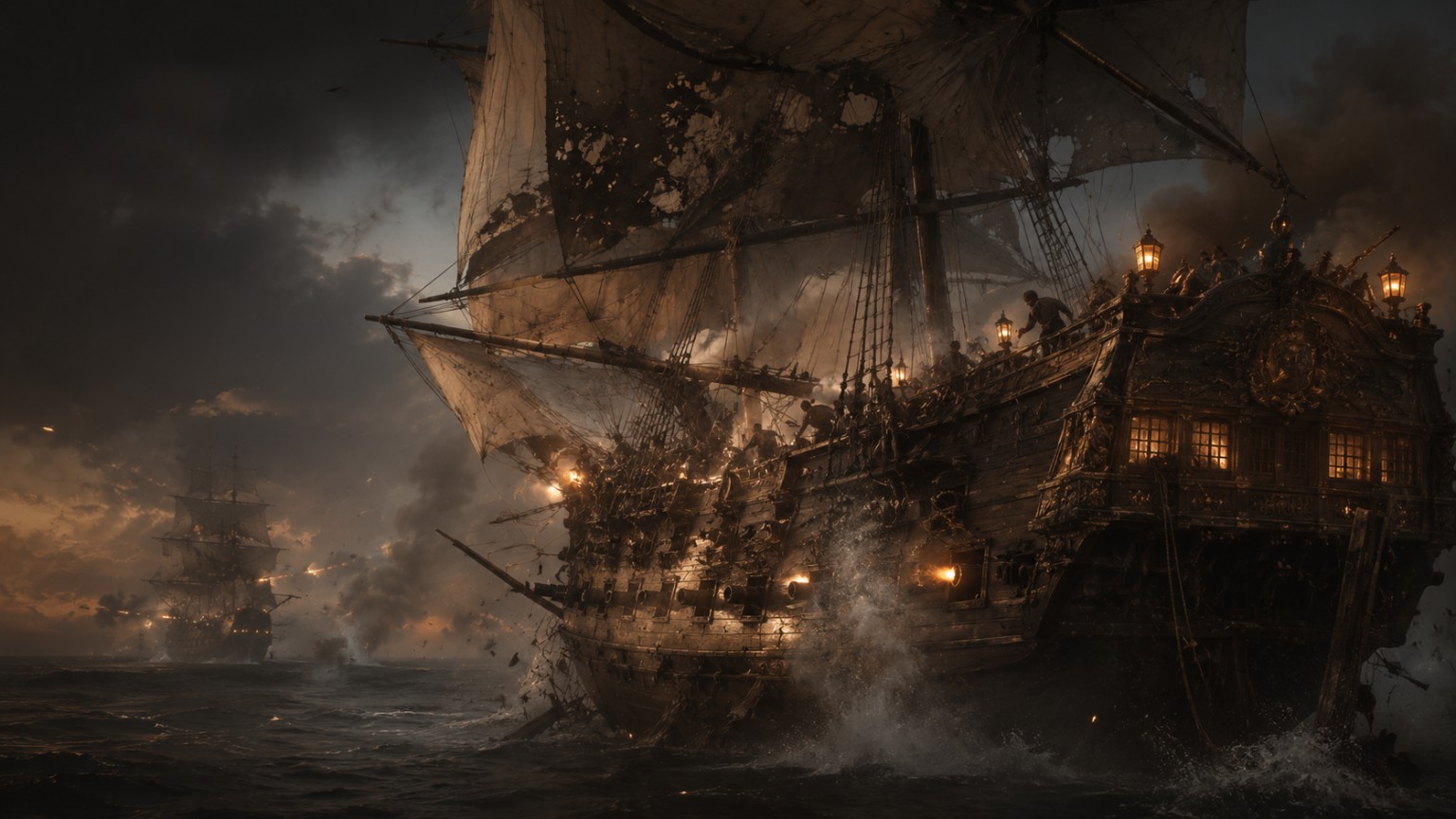
Naval Combat and Ships for D&D 5e
Vessel stat blocks, broadsides, subsystem damage, boarding, and repair or resupply.
Mar de Oro resolves ship-to-ship fighting through a vessel economy of systems. A vessel normally makes one attack on its turn, Broadside is the total damage of that attack, and damage can affect Hull, Rigging, Weapons, Crew, or Command. Boarding returns the action to Personal Scale.
These are the base vessel procedures used for conventional naval warfare. Airship combat uses the same attack economy, Broadside logic, physical protection, and boarding procedures, then adds the systems and geometry required for flight.
Small arms on deck stay on the 5e firearms and musket rules, which cover boarding guns, swivel guns, reloading, and misfires.
Taking the battle into the sky? See Airship Combat for D&D 5e.
Compatible with D&D 5e and D&D 5.5e.
Vessel systems
Track vessels by role and by these systems, not by a single HP pool:
- Hull
- Rigging
- Weapons
- Crew
- Bridge or Command
Vessel Attacks and broadsides
Each vessel normally makes one vessel attack on its turn unless a specific vessel trait explicitly states otherwise. The Broadside value represents the total damage of that single vessel attack. It is not rolled once per cannon, gun deck, battery, or listed weapon.
Broadside represents the available battery. Equivalent cannon batteries produce equivalent Broadside damage whether mounted on a sailing ship or an airship. Flight does not make the cannon itself more destructive.
Naval Reference Roster
These profiles are quick-reference templates for sea-going warships using the Mar de Oro Fifth Edition vessel rules. They represent broad naval roles rather than named canonical vessels. Individual ships may vary with design, condition, crew, armament, and refit.
| Vessel | AC | HP | Speed | Broadside |
|---|---|---|---|---|
| First-Rate Ship of the Line | 17 | 1,200 | 10 kt | 72d12 |
| Second-Rate Ship of the Line | 17 | 900 | 11 kt | 56d12 |
| Heavy Frigate | 16 | 580 | 12 kt | 28d12 |
| Frigate | 16 | 340 | 14 kt | 24d10 |
| Light Frigate / Corvette | 15 | 250 | 15 kt | 16d10 |
| Sloop-of-War | 14 | 160 | 16 kt | 8d8 |
| Cutter / Dispatch Vessel | 13 | 100 | 18 kt | 4d8 |
These are website-only quick-reference profiles and do not appear in the downloadable Fifth Edition Conversion Pack.
Battery and platform
A cannon does not become more powerful because its vessel can fly. Broadside damage represents the vessel’s available battery. Equivalent batteries therefore deal equivalent damage on sea-going ships and airships.
What changes in the air is the ability to bring that battery into action: engagement range, firing angle, speed, and three-dimensional position.
Naval engagement geometry
Sea combat is two-dimensional but highly positional. Speed, bearing, weather, wind, and firing arcs determine whether a vessel can bring its battery to bear and whether it can control or escape an engagement. Important questions include range, approach, pursuit, crossing or denying an enemy firing arc, and holding the weather gauge or denying a favourable approach.
Ships need not use the 10-yard land grid. Range, bearing, weather, firing arcs, and relative position are sufficient encounter geometry.
Vessel movement on a grid
Ships do not require a square grid. Bearing, weather, wind, firing arcs, and relative position can be handled abstractly.
If you use the 10-yard Battlefield grid, treat 3 knots as approximately 1 square of vessel movement per round.
Divide the vessel's current speed in knots by 3 and round to the nearest whole square.
| Current Speed | Grid Movement |
|---|---|
| 10 kt | 3 squares |
| 11 kt | 4 squares |
| 12 kt | 4 squares |
| 14 kt | 5 squares |
| 15 kt | 5 squares |
| 16 kt | 5 squares |
| 18 kt | 6 squares |
Use current speed, not listed maximum speed. If a vessel slows, accelerates, or operates in a different Combat Speed band, convert the speed it is actually making that round.
This conversion is optional and does not replace abstract naval positioning.
Subsystem shares
| Subsystem | Share of Vessel HP |
|---|---|
| Hull | 35% |
| Rigging | 20% |
| Weapons | 20% |
| Crew | 15% |
| Bridge or Command | 10% |
Use the Game Master’s Guide half-HP degradation and zero-HP failure consequences for each subsystem. The subsystem controlling sails, steering, and manoeuvring is Rigging.
Optional Rule: Combat Speed
When speed, pursuit, escape, or positioning matters in a vessel engagement, use Combat Speed states. A vessel cannot normally operate at maximum speed while also maintaining a stable full-broadside firing solution.
| State | Speed use | Gunnery |
|---|---|---|
| Battle Station | 40–60% of listed top speed | Full Broadside, normal accuracy |
| Manoeuvring | 60–80% | Partial Broadside or accuracy penalty |
| Dash / Breakaway | 80–100% | No Broadside, or sharply reduced and inaccurate fire |
The GM chooses the exact consequence appropriate to the manoeuvre, conditions, and firing geometry.
Top speed is primarily a positioning statistic. A fast vessel can choose engagements, pursue, escape, cross firing arcs, or seize favourable position, but it cannot normally race at maximum speed while delivering a stable full Broadside every round.
Use this optional rule when the distinction between battle speed and maximum speed matters. For simpler engagements, use listed vessel speeds normally.
Boarding
Boarding has no fixed range. A Boarding Opportunity exists when two vessels can be brought close enough, and kept sufficiently stable relative to one another, for crew to cross.
The GM determines when this is possible from the circumstances. Relative speed, bearing, damage, weather, entanglement, anchoring, loss of steering or propulsion, surprise, surrender, and similar conditions may create or prevent a Boarding Opportunity.
Simply passing close to another vessel is not enough. Ships moving rapidly past one another, fighting through heavy seas, or otherwise unable to maintain relative position cannot normally be boarded.
Once a Boarding Opportunity exists, the vessels may be brought alongside, against the quarter, across the bow, or into another position from which crews can cross. Grapnels, lines, boarding bridges, direct contact, or other appropriate means are then used to hold them together.
The manoeuvring, throwing of grapnels, hauling on lines, and securing of the vessels is normally resolved narratively. If a player character personally attempts something risky or decisive during this process, resolve it with an appropriate ability or vehicle check.
Once the vessels are secured, resolve the boarding according to who is taking part.
Crew-Only Boarding
If no player characters personally join the boarding action, compare the current HP of the two vessels.
The vessel with more current HP wins the boarding action. No roll is made.
Current vessel HP abstracts the effective strength remaining aboard the vessel at the moment of contact, including casualties, damage, disorder, lost fighting capacity, and the condition of the ship itself.
If both vessels have the same current HP, neither side has a clear advantage. The boarding remains contested until circumstances change or the GM resolves the situation from the established fiction.
No separate crew statistics, boarding attack rolls, morale checks, or individual sailor combat are required.
Player Characters Boarding
If one or more player characters personally join the boarding action, do not resolve the result by comparing vessel HP.
Instead, use a Boarding Clock under the normal Clock rules and switch the characters involved to Personal Scale.
Roll initiative normally. Boarding applies no special modifiers to initiative.
Player characters, significant NPCs, and relevant enemies act normally using the Fifth Edition combat rules. Their actions, successes, failures, casualties, and objectives affect the Boarding Clock as appropriate.
The relative condition of the vessels should inform the situation represented by the Clock. Boarding from a relatively intact vessel onto a badly damaged enemy is very different from leading the surviving crew of a crippled frigate onto an intact ship of the line.
Once aboard, characters may attack accessible crew, weapons, command positions, engineering spaces, and other exposed or internal components normally. Personal-scale weapons still cannot meaningfully damage an intact vessel hull from outside.
Command
When a player character directly leads or coordinates crew during a boarding action, use an ability check appropriate to what the character is actually doing.
Charisma (Persuasion) is the normal choice for rallying willing crew, maintaining cohesion, and issuing confident orders.
Other skills may apply when the approach supports them:
- Charisma (Intimidation): driving frightened or wavering crew forward through fear or force of authority.
- Wisdom (Insight): reading morale, hesitation, or where resistance is beginning to break.
- Intelligence (History): applying known naval doctrine, boarding tactics, signals, or established military procedure.
The GM may allow another appropriate proficiency when the character's approach clearly supports it. Command is not a separate skill.
Physical protection
An intact warship hull is immune to ordinary small-arms structural damage. Exposed crew remain vulnerable. Internal components can be targeted with Personal Scale weapons only after physical access is gained through boarding, a breach, a hatch, or another credible route.
Damage and depletion
Sailing warships normally track two kinds of problem at Vessel Scale:
| Problem | Meaning | Answer |
|---|---|---|
| Damage | Structure, rigging, weapons, or machinery is physically broken. | Repair |
| Depletion | Ammunition, provisions, or another consumable resource is spent. | Resupply |
Repair restores structure. Supply restores capacity.
For the vessels themselves as fiction rather than statistics, read Ships of Sea and Sky. To see how the wider archipelago supports sea campaigns, explore Mar de Oro as a naval TTRPG setting.